Like many other verticals, including corporate and hospitality, the relationship of AV to healthcare has undergone a profound shift in recent years. Where once facilities were regarded individually – and even within a given location there were silos of activity that had little to do with each other – the modernisation of healthcare technology infrastructure has advanced to the point that the term ‘the connected hospital’ is now commonplace.
Of course, individual systems such as displays and conferencing platforms are still important to facilities, and it’s vital they continue to engage AV specialists in choosing the right solutions for their often expanding needs. Nonetheless, it’s hard to argue against the view that the most exciting development concerns the underlying platforms – such as those used for overall management and patient communications – and how they support, among other areas, connected clinical workflows and remote consultations and diagnoses.
In this article we’ll look at the current state of modernisation – which, inevitably, varies considerably depending on territory and economic circumstances – and how AV is increasingly becoming part of the digital infrastructure that supports every operational dimension of the modern healthcare facility.
CONNECTED DEFINITIONS
It stands to reason that – as in every other major building that has a complex and extensive usage of AV and other technologies – the extent of integration will vary between healthcare sites, often extensively. But the core definition offered by Erik Håland, senior project manager at AV and workplace technology integrator Kinly, does work universally.
“A connected hospital is one where technology brings clinical, educational and operational environments together, rather than serving each department in isolation,” he says. “That requires a consistent AV strategy across a wide range of spaces, from smaller meeting rooms to larger conference facilities, multidisciplinary team rooms, training spaces, auditoriums and command centres.”
Mike Sullivan-Trainor, senior industry analyst for AVIXA, draws attention to the full scope of the connected hospital. He says it requites an “integrated infrastructure” where clinical systems (EHR/EMR, imaging, and patient monitoring) are connected to a communications system (voice, video, messaging), building systems (security, environmental and room management), AV systems (digital signage, wayfinding, and collaboration spaces), and an analytical platform.

No two healthcare facilities are likely to be the same, but many do share a common goal for increased integration – yielding the ability to share data, information and specialist insight wherever it is needed. For instance, says Sullivan-Trainor, a video-conferencing session involving hospital leaders would allow them to “look at clinical system scheduling and performance, reach out to staff across the communications system, check security and building conditions, and view comprehensive analytics”.
HOSPITAL EXPERIENCE
Given that no hospital will have every clinician or resource in one location, a connected facility can be hugely beneficial to everything from patient diagnoses and decision-making to building management, security, education and oversight by hospital boards and regulatory authorities. Moreover, with more specialists often now joining meetings or offering insight at a distance, this connected environment also serves remote collaboration more fluently.
“AV is helping hospitals improve collaboration, training, operational oversight and communication,” says Håland. “In multidisciplinary environments, clinicians can display medical images and other information at the same time, allowing specialists in different locations to review the same material and contribute their perspectives. Collaboration platforms can also connect teams beyond the hospital, widening access to expertise without requiring everyone to be physically present.”
There is general agreement that training has also been hugely advanced by the rise of the connected hospital. David Slavitt, US representative at MSolutions, notes that medical device manufacturers can construct simulated emergency rooms, operating rooms and recovery areas where real-life scenarios can be recreated, with cameras, displays and collaboration platforms then able to bring sessions to staff and trainees located elsewhere.

He adds: “That creates opportunities to train people on new medical devices and procedures without requiring everyone to be physically present. The same underlying AV technologies that support collaboration in corporate and educational environments therefore take on specialised roles in healthcare, whether connecting clinicians, extending training or sharing expertise across locations.”
By applying this methodology, the whole notion of training can be rendered more accessible, whilst also reducing impact on day-to-day operations. Sebastian Mucha, executive VP sales and strategy at MultiDyne, observes:“Instead of bringing students into an operating room, high-res video can be transported from surgical cameras and other appropriate video sources to a control room and then distributed to lecture theatres or training rooms. Students can observe procedures in detail while the clinical team continues working without unnecessary disruption.”
A more connected environment is also making it easier to improve the patient experience – for example, the use of accessible platforms is allowing patients to access more education and entertainment content, as well as service requests and room controls from a unified interface.
Aside from what’s happening with regard to the patient wards, rooms and consultation rooms, the connected hospital makes it easier to support the day in, day out operation of an estate. Examples include command centres that can bring together CCTV, alarms and other important information – giving operational teams a holistic view of an entire site – and centralised management platforms, which allow arge numbers of connected devices to be monitored and managed from one place. “Having greater visibility across the estate makes it easier to identify issues before they disrupt users,” says Håland.
ESSENTIAL INFRASTRUCTURE
As to the infrastructure that is enabling these next-generation hospitals, there is a true consensus that it’s all about the network, with IP- and/or cloud-based networked platforms making it possible to scale and expand installations as and when further capacity is required. This unified approach – which means effective cooperation between AV and IT departments – is also opening the door to improved cybersecurity and reduced potential data breaches (something that has, let’s face it, been an issue that has hit the headlines far too frequently in recent years).
Sullivan-Trainor notes on the IP networking, and the increased collaboration between AV and IT technicians: “AVoIP is a game changer as it allows a common data and voice communication infrastructure, shifting silos and proprietary barriers that once governed healthcare systems. To accomplish AVoIP and a common infrastructure, cooperation between AV and IT is critical.”
For Jonathan Boutin, director of marketing at workplace solutions company Humly, the foundation is a strong network, interoperability, centralised management and secure systems that can scale across the hospital. He says AVoIP, cloud platforms and open integrations make it easier to connect systems and manage them, adding: “Cybersecurity also has to be built in from the beginning, especially in an environment where downtime and data breaches can have serious consequences. This also means AV, IT, cybersecurity, estates and clinical teams need to work much more closely together.”
This point is stressed repeatedly by our contributors, as network infrastructure integration becomes more commonplace. And as Håland indicates, there are a lot of issues that have to be fully explored and verified. Network requirements, access controls, device configuration and vendor guidance must be considered from the outset rather than addressed after installation. “AV, IT, estates and clinical stakeholders therefore need to work together to ensure the infrastructure is secure, technically compatible and appropriate for the way each space will be used,” he believes.
CENTRAL MONITORING
In terms of successful long-term strategies, it’s also important to identify which systems require central monitoring. Inevitably, given different specialisms at separate facilities, this will vary. Håland notes: “If only some devices are visible to support teams, hospitals may still be left with blind spots across the estate. Designing management and monitoring into the overall architecture creates a more supportable and consistent environment.”
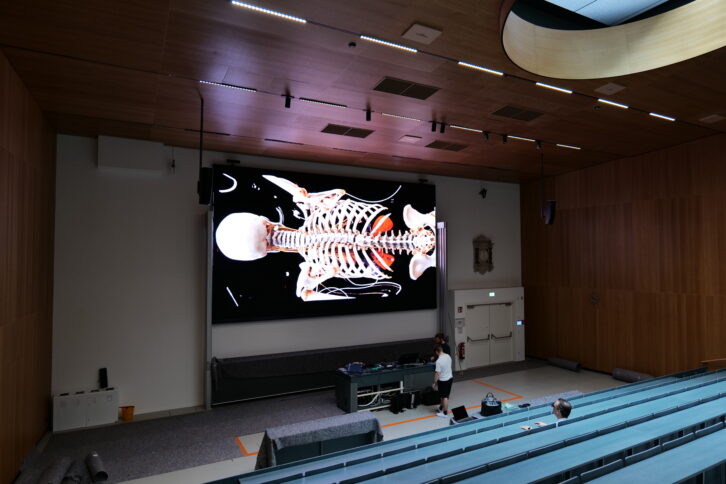
Meanwhile, on the teaching side, many hospitals are working to upgrade their collaboration and visualisation solutions. A recent project at the Medical University of Graz, which uses dVLED technology from Sharp/NEC and combines 3D and LED technologies to teach anatomy, is towards the higher end of what can be achieved. But even with more modest ambitions, there is an awareness that the cameras and displays have to be of broadcast quality to get the optimum results.
More generally, Sullivan-Trainor notes that a recent AVIXA study showed that hospitals are spending more on AV. Digital signage is the most frequent area of investment to improve patient experience in waiting rooms and for moving around the medical facility. AV conferencing and collaboration technology is next, closely followed by specialised videoconferencing solutions to provide remote medical examination and advice to patients with varied AV setups. Projector and displays for training applications, as well as simulation for procedure practice, are another specialised area.
Sullivan-Trainor also highlights a trend towards outfitting surgical theatres with real-time imaging and data solutions to support operations, adding: “Together these investments are making collaboration available anywhere to improve operational efficiency and patient experience.”
FUTURE HOSPITALS
It should have emerged clearly in this article that the modern hospital is one that is increasingly viewed – both by those who work and are treated there – in a holistic way. More and more, the technologies that are chosen for healthcare facilities need to work together intelligently – a requirement that will surely mean there is a major role in these spaces for AI.
Mucha believes that AI and automation will increasingly help healthcare organisations manage large volumes of information, identify what requires attention and make resources available more efficiently. He says: “From an AV perspective, that could mean smarter routing and management of video resources, automated room configurations, centralised monitoring, proactive system maintenance and more intelligent management of recorded and live content.”
From the connected hospital, we might now be moving towards the era of the ‘intelligent and adaptive’ hospital. Boutin notes: “AI and automation can help identify patterns, predict issues, improve how spaces and equipment are used, and automate repetitive operational tasks. But the biggest challenge will not be adopting AI itself; it will be making sure the data, integrations, security and governance are good enough to support it. The best technology will probably be the technology people barely notice because it just works in the background.”
There is no doubt that security and governance constitute a massive operational challenge for healthcare, in particular, where the privacy of patient data is of the utmost importance. The number of major data breaches in this sector in recent times only adds to the concern that the introduction of AI could add a further, rather unpredictable dimension. So it’s incontrovertible that there must be effective, independent regulation – something that, in the UK at least, has been found wanting across utilities and private sector organisations.
Jason Cremins, CTO of Navori Labs, says the biggest challenges are around governance: “Who approves AI-generated content? Where does data go, and who can see it? How do you secure thousands of connected devices across an estate that changes every year? Accessibility regulation is also tightening, so screens and content need to work for everyone who uses the building. Organisations that agree those answers early will find the rest much easier.”
CONNECTION RISKS
Håland points out that the challenge will be connecting these capabilities without introducing unnecessary complexity or risk. Providers should prepare for greater cybersecurity exposure as more systems and devices join the network, as well as because of the need to protect sensitive patient data, establish clear governance and maintain human oversight of AI-supported decisions. “They must also address interoperability between new platforms and existing infrastructure, ensure data is accurate and accessible, and equip staff to use new tools with confidence,” he says.
So it feels like the stakes are pretty high for the next generation of connected hospitals, but if AI can be effectively harnessed – and is properly regulated, with severe penalties for those who break the rules – then there will be even more benefits in terms of efficiency, knowledge-sharing and, ultimately, good patient outcomes.
You can subscribe to Installation magazine for free here and the daily newsletter here.